
Bird Flight - How Do Birds Fly?
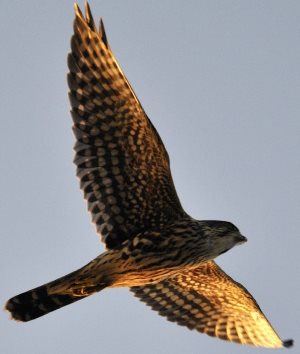 Listed below are adaptations for bird flight. In order to fly, a bird must solve two basic problems: the reduction of weight and the increase of power.
Most of the anatomical and physiological differences that set birds apart from other vertebrates seem to be adaptations devoted to the solution of these two problems.
Modern aviation technology has all been derived from the study of birds' flight mechanics.
It may be a long while before any type of aircraft will have the kind of abilities that birds have when it comes to flying. Below are discussed some of these marvel adaptations that birds have for flight.
Codes for different bird flight adaptations:
- W = Weight-reducing
- E = Energy promoting
- S = Structural
- B = Balancing
- O = Orienting
- A = Aerodynamic
BRAIN
-
Olfactory lobes greatly reduced (W)
-
Cerebellum well developed for coordination (O)
EYES
- Eyes large with wide field of view and some binocular vision (O)
- Nictitating membrane a third eyelid that is transparent or translucent so that a flying bird can blink and not be momentarily blinded (O)
- Eyes, fixed in position, are moved with the head by neck muscles (W, B)
- Sclerotic ring of bony plates protects eye and increases the distance between the lens and retina for keen distance vision (O)
BODY SHAPE
- Short and compact compared to other animals (S,B)
- Most organs and large muscles are located near the center of gravity, which is slightly below and behind the wings (B).
- Bilateral symmetry (B, A)

BLOOD
- High blood pressure (E)
- High blood sugar (2 X mammal glucose levels) (E)
- Better fliers have smaller red blood cells with greater surface-to-volume ratios for greater oxygen-absorbing capability (E).
HEART
- 4-chambered with pulmonary circuit to lungs (E)
- Large and powerful (E)
LUNGS
-
Air "capillaries" (parabronchii) circulated air through the lungs (E)
-
Air sacs in dorsal body cavity lower the center of gravity and aid in respiration so there is no residual air (B,W,E)
-
Oxygen exchange probably occurs during both inhalation and exhalation (E)
 FEATHERS
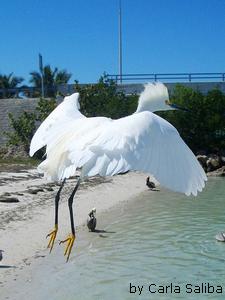
- Contour body feathers decrease drag (A)
- Down feathers for insulation (E)
- Primary feathers are "wings" (A)
- Provide wing shape (A)
- Hollow (W)
More information about bird feathers.
METABOLISM
- High metabolism for quick reactions and power (E)
- Endothermic (E)
GONADS
- Ovaries and testes reduced in size outside of the breeding season (W)
- Usually only one functional ovary, the second ovary greatly reduced in size. Female liver is moved to compensate for weight difference (B,W)
- Young develop outside mother's body in a hard protective egg (W)
More information about bird reproduction.
PECTORAL GIRDLE
- Coracoid, furcula, and scapula form a sturdy tripod for supporting the wings (S)
- Broad surfaces for the attachment of large flight muscles (S)
SPINE
- Vertebrae fused for a stable air frame (S)
LIMBS
- Leg muscles are close to the body (E, B)
- Legs are tucked next to body in flight (A)
- Forelimbs (wings) attached closer to center of gravity and farther from head than in other animals (B, A)
- The natural motion of forelimb is up and down, rather than back and forth (as in other animals) (S, A)
- Forelimbs fold into a "Z" close to the body (A)
- Hand bones are small, fused, flattened and specialized to manipulate the flight feathers (S, W, A)
- Aerodynamic shape of forelimb provides lift and propulsive force (A)
More information about the bird skeleton.
DIGESTIVE SYSTEM
- Consume high-energy foods such as insects, seeds, fruits, meat, and nec- tar (E)
- Extremely efficient in absorbing energy from small amounts of food (E,W)
- Digestion is very rapid (W)
EARS
- No external ears (A)
Slow Motion Flight of Anna's Hummingbird
Hope you enjoyed learning about all the different adaptations of bird flight. You can now better appreciate the marvel of bird flight and on days wish you could be as free as a bird:
"When once you have tasted flight, you will forever walk the earth with your eyes turned skyward, for there you have been, and there you will always long to return."
-Leonardo da Vinci
Related Bird Anatomy Pages:
Learn About Other Bird Characteristics
Photo of Merlin courtesy of Bill Thompson, USFWS.
|
Our Favorite Bird Watching Binoculars, Squirrel-Proof Feeder & Hummingbird Feeder Read Our Reviews: |
||
Nikon Monarch M5
Best mid-priced bird watching binoculars. Waterproof, shockproof, multi-coated ED-Glass. |
|
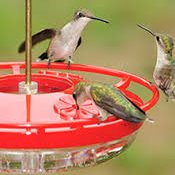
Best Hummingbird Feeder
Drip-Free, Ant-moat, Durable, Easy to Fill and Clean. |
| Click Images or Links To View More Info | ||
Subscribe to Our FREE Newsletter: The Birder Alert!

