The California Quail, also known as the topknot quail or the valley quail are a widely distributed and prized game bird. It is known for its hardiness
and adaptability.
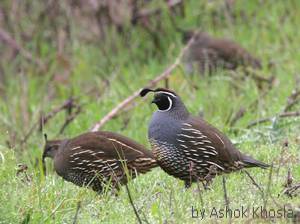
The plump, gray-colored birds are smaller than a pigeon and the California Quail sports a downward curving black plume on top of its head
and black bib with white stripe under the beak.
Flocks number from a few to 60 or more in the fall and winter months, but the form pairs in the spring to
start the breeding season. They are common in neighborhoods where everyone is familiar with their "Chicago" call.
Official California State Bird: California Quail
American Ornithologists' Union Common Name: California Quail
Other Names: Topknot Quail, Valley Quail, Crested Quail, California Partridge
Family: Odontophoridae - New World Game Birds; California Quail and Bobwhite Quail
Scientific name: Callipepla californica
Length: 10" (25 cm)
Diet: Seeds, foliage, acorns, fruit; insects, spiders,
snails, etc., account for <5% of diet.
Voice: Male song a repeated, nasal put way doo
similar to Gambel's, but final note longer and descending,
individually variable. Other calls include relaxed waaaaw
or waay; rapid spitting spwik wik wiw; shar,
metallic alarm pit-pit; soft clucking ut, ut...
Habitat: Common in open woodlands, brushy
foothills, stream valleys, suburbs, usually near permanent water
source; broken chaparral, woodland edges, coastal scrub, parks,
estates, farms.
Displays: Courtship: male bows, fluffs feathers,
droops wings and, with tail spread, may rush toward female. Males
often fight.
Number of broods: 1, 2 in exceptionally favorable years.
Nest: Usually concealed in grass or shrubs or
next to log or rock, occasionally 10' above ground in bush or
tree; shallow covered depression lined with dead leaves, grass.
Eggs: Averages 12-16 white to creamy eggs, marked
with dull browns. 1.2" (31 mm).
Incubation period: 18-23 days
Fledge: 10 days after hatching
Longevity Record: 6 Years and 11 months (according to USGS Bird Banding Lab
but they no longer present data for game birds, because they are no longer banded with USGS bands)
California Quail
This is an excellent video showing Males calling and females watching over chicks as they forage and the female broods them when they stop to rest.
Chicks can be seen when very small, then again when about half grown. A good example of California Quail living in a neighborhood.
History:
The California Quail became the official California State Bird in 1931.