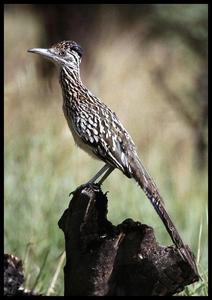
U.S. State Bird of New Mexico
- Greater Roadrunner
The Greater Roadrunner is an iconic bird of the Southwest Deserts, but they are also found in shrubby habitats across the Southern Great Plains East to
the Mississippi River. Roadrunners are easily to identify as they run around on the ground looking for prey.
Since birds originated from dinosaurs, it is not hard to imagine the first birds probably moved a lot like a roadrunner before birds evolve the ability
for sustained flight.
They spend most of their time running on the ground, but they can fly when they want or need to. They are very fast and agile and prey on a variety of
snakes, lizards and small birds (see videos below).
Official New Mexico State Bird Name: Roadrunner
American Ornithologists' Union Common Name: Greater Roadrunner
Other names: chaparral bird or chaparral cock
Family: Cuculidae, Cuckoos, Roadrunners, Anis
Scientific name: Geococcyx californianus
Length: 23" (58 cm)
Diet: Animals (90%), including insects, lizards, snakes,
rodents, birds (especially passerines); fruit (especially cactus) and seeds.
Voice: Meep Meep (just kidding!)
Song is a slow, descending series of about six resonant, low-pitched coos: cooo
cooo cooo cooo coo coo; weaker at end. Also a low, hollow, wooden
clatter or rattle trrrt sound produced with the bill.
Habitat: Common in scrub desert and mesquite
groves; less common in chaparral and open woodland.
Displays: Male parades with head held high and stiff, wings
and tail drooped; precedes male mating song. Male also bows,
alternately lifts and drops wings while spreading tail.
Number of broods: 1, occasionally 2.
Nest: Usually in low tree, thicket, or cactus
clump. Of sticks, lined with leaves, grass, feathers, mesquite pod,
snakeskin, roots, and manure flakes. Occasionally atop woodrat nest.
Eggs: Averages 4-6 white eggs with chalky
yellowish coat. 1.5" (39 mm).
Incubation period: 20 days
Fledge: 18 days after hatching
Longevity Record: 3 Years and 9 months (according to USGS
Bird Banding Lab). They undoubtably live longer, but a banded
bird has never been recaptured over a longer time span to prove it.
Greater Roadrunner Nest
Listen and watch carefully to hear and see chicks bill rattle (It happens fast). Then watch a chick leave the nest in a low catcus.
Greater Roadrunner Kills Rattlesnake
Sorry about the dramatic music and the hollywood editing. We would prefer natural sounds and unedited behavior, but we show this video so you can understand
that the roadrunner is a serious predator. Real nature is exciting enough.
The chaparral bird, commonly called roadrunner, was adopted as the official New Mexico State Bird in 1949.