
Red-tailed Hawk
(Buteo jamaicensis)
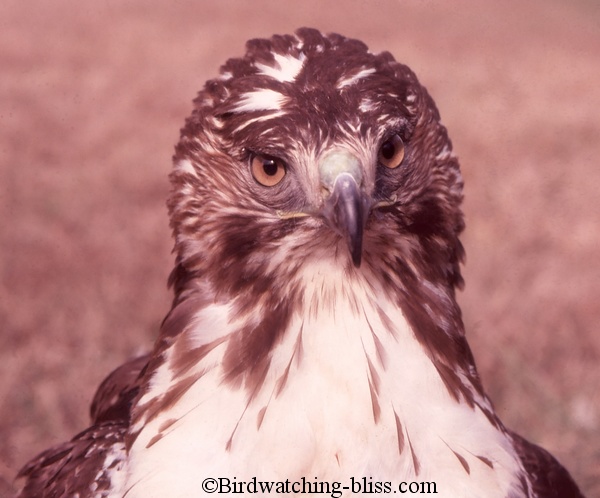
The Red-tailed Hawk is North America's most common and most wide-spread Buteo.
"Red-tails" breed throughout North America in forested areas, mountains, treeless plains and deserts. A famous pair even breeds in Central Park in New York City (Pale Male). Watch Pale Male bring food to the nest in video below.
Red-tailed Hawks (Red-tailed Hawk) (like most raptors) are reverse size dimorphic, meaning that the females are larger than the males. But the difference is size between males and females is not as large as with Falcons or Accipiters.
Pale Male (Red-tailed Hawk nesting in New York City brings food to the nest at 3:55.
Red-tailed Hawk Size
Data for length, wingspan and weight below (males and females combined) is from A Photographic Guide to North American Raptors (Wheeler & Clark 1995). We highly recommend this book for anyone interested in raptors.
Wingspan: 43-56 inches (110-141 cm)
Weight: 710-1550 grams (18-53 oz)
Red-tailed Hawk Wing** (Friedmann 1950; N males=35, N female=27)
Males: mean 369.6 mm (337-396)
Females: mean 388.8 mm (370-427)
Red-tailed Hawk Tail (Friedmann 1950; N males=35, N female=27)
Males: mean 215.6 mm (197-240)
Females: mean 230.3 mm (214.5-254)
Red-tailed Hawk Weight (Snyder and Wiley 1976)
Males: mean 1028 g (n=108)
Females: mean 1224 g (n = 100)
We have found (as have others) that Western Red-tailed Hawks have longer Wings and Tails than Eastern birds (See data below).
The data below were collected while we were doing research on Red-tailed Hawks. Male and female data are combined.
Red-tailed Hawk un-flattened Wing Chord*
Eastern: mean 378.3 mm (350-406)
Western: mean 403.5 mm (370-430)
Red-tailed Hawk Tail Length
Eastern: mean 210.0 mm (185-250)
Western: mean 238.5 mm (211-285)
Western Red-tailed Hawk Weight
mean 1011.6 g (595-1612)
**Wing from Friedmann data assumed to be un-flattened wing chord.
*Wing Chord is measured from from the wrist to the tip of the longest primary feather
on one wing. The primary feathers have a
natural camber (bend), and can be measured flattened or un-flattened.
Red-tailed Hawk Diet: Approx. 85% small-medium sized mammals (mice, voles, rabbits, hares and squirrels), as well as small-medium sized snakes and lizards. They are also known to eat insects, birds and bats. Watch Red-tailed Hawks catch bats in BBC video below.
I witnessed a soaring Red-tailed Hawk snatch a small bird out of the air that flew too close (probably an American Goldfinch or Pine Siskin). The Red-tail stooped after the bird while it spiraled downward and grabbed it. The Red-tail then resumed soaring and ate the bird "on the wing". There were at least 40 other observers at a Hawk Mountain (migration observation site) that witnessed the event that day.
Red-tailed Hawk Nest: Usually 28 - 30 inches in wide, with an inner cavity of 14 - 15 inches diameter and 4 - 5 inches deep. The nest is made of sticks and twigs (usually one-half inch thick or less). The nest cup is lined with strips of bark and fresh greenery, usually an evergreen sprig.
The nest is usually placed in the crotch of a large tree or on a cliff ledge at least 25 feet above the ground. Most nests are 15-70 feet high.
I found and climbed into a Red-tailed Hawk nest that was 92 feet up in the broken top of a white pine to band the chicks. Their nest sites usually have a commanding view of the area. I also banded a chick in a Red-tailed Hawk nest that was on a cliff ledge about 100 feet above the ground.
Nest Construction usually begins in February or March.
Red-tailed Hawk Eggs: The clutch almost always consists of 2 eggs in the Eastern U.S. and Canada and 3-4 (and even 5) in the Central and Western parts of North America.
Average size: 59 X 47 mm. (Bent, 1937)
Eggs are usually dull or dirty white (sometimes a pale bluish or greenish white). Eggs can be un-marked, but usually have some reddish to brownish markings or blotches that may be either faint or dark.
Egg laying usually begins in March or April. Eggs are usually laid 30-48 hours apart.
Red-tailed Hawk Incubation period: 28-30 days for each egg, but since incubation usually begins with the first egg, an additional one or two days is needed for each additional egg. A two-egg clutch may be incubated 30-32 days and nests with 3 eggs may be incubated for 32-34 days.
The first egg will hatch one or two days before the second egg, and a third egg would hatch another day or two later.
Red-tailed Hawk Fledging: Chicks usually make their first flight between 40-46 days after hatching and fledging usually occurs between late May and Mid July.
Longevity Record: 28 Years and 10 months; based upon known age of a wild Red-tailed Hawk at banding and subsequent band recovery (Data from Bird Banding Lab (Klimkiewicz 2008).
Red-tailed Hawk Migration: Red-tailed Hawks migrate from the Northern parts of the breeding range during late Autumn. There are many raptor migration sites where Red-tailed Hawks can be viewed during Migration (See Raptor Migration Sites).
Sub Species: There are six races or subspecies of Buteo jamaicensis in North America and 8 additional subspecies in the Caribbean, Central America and Mexico see Red-tailed Hawk Subspecies here.
Related Information about Red-tailed Hawks:
Red-tailed Hawk Identification
|
Our Favorite Bird Watching Binoculars, Squirrel-Proof Feeder & Hummingbird Feeder Read Our Reviews: |
||
Nikon Monarch M5
Best mid-priced bird watching binoculars. Waterproof, shockproof, multi-coated ED-Glass. |
|
Best Hummingbird Feeder
Drip-Free, Ant-moat, Durable, Easy to Fill and Clean. |
| Click Images or Links To View More Info | ||
Subscribe to Our FREE Newsletter: The Birder Alert!

