
Free Wren House Plans
Easy DIY Project To Attract Carolina, House, Bewick, & Winter Wrens
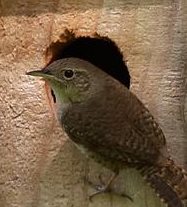
Here are wren house plans you can easily follow to make your very own wren bird house.
If you use the specifications outlined in these bird house plans, you will increase your chances of attracting wrens to use the nest box.
The Importance of Hole Size
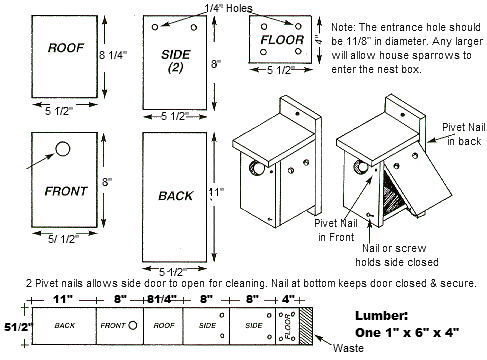
One of the most important design elements in building any bird house is the hole size. The hole diameter will determine who or who cannot use your wren nest box.
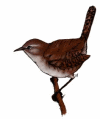 For
House Wrens,
Winter Wrens and Bewick's Wrens, you can make the hole diameter 1 1/8"
which is also large enough for black-capped chickadees.
For
House Wrens,
Winter Wrens and Bewick's Wrens, you can make the hole diameter 1 1/8"
which is also large enough for black-capped chickadees.
A 1 1/4" hole will allow Carolina Wrens and White-breasted Nuthatches to use the box, but also will allow unwanted house sparrows to enter as well.
Other species of wrens such as marsh wrens, sedge wrens, cactus wrens, and canyon wrens are not likely to use a nest box.
I have found wide variation on hole sizes required for different wren species from 1 1/8" to 1 1/2" needed.
If house sparrows are not an issue in your area, then you may want to start with a bigger hole size, such as 1 1/4", otherwise stick with the 1 1/8" hole.
Below is a wren bird house plan from the Natural Resources Conservation Service. A more detailed view is provided from the MN DNR further below (see highlighted arrow next to small image).
Wren House Plans Layout
Be sure to mount your wren birdhouse where predators such as cats, snakes or raccoons cannot easily reach the nest box and have access to the adults or nestlings.
Do not add a perch to the box because this will allow birds such as starlings to land.
Wren House Placement
You can place the nest box from these wren house plans 5-10 feet above the ground, under the eaves of a building or a tree limb.
Wren boxes can also be firmly fixed to the side of a building or tree or can be hung freely from a wire.
Carolina wrens prefer a house that is more hidden, like around shrubs or trees, than exposed and in a wide open space.
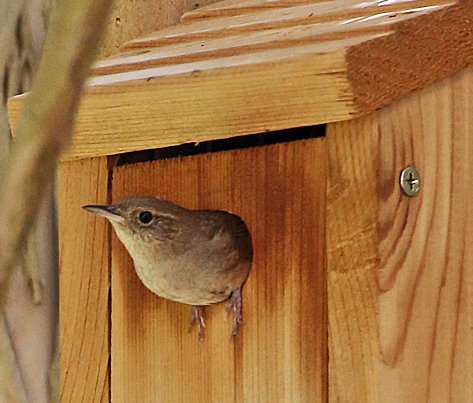
We have seen wrens build nests in hanging plant baskets and even in the mouth of an old flounder skeleton that was mounted on the outside wall of a shed!
To attract wrens to your backyard and to ultimately use your bird house, place suet, peanut butter or meal worms in nearby feeders.
Below is another more detailed diagram for wren houses from the Minnesota Division of Natural Resources.
Click on the small thumbnail image to view larger plans in a new window.
You can then print the plans using your browser or save the image to your computer to view or print at a later time.

Wren House Plans How To Build Video


Note: House wrens can become very territorial and aggressive during the breeding and nesting season.
So much that they have become a problem for those who wish to have other cavity nesters such as bluebirds nesting in their bird houses.
Eco-Friendly Wren House Design
Here is an eco-friendly wren house that is made from recycled plastic - just another alternative to using wood, easy to clean and long-lasting:
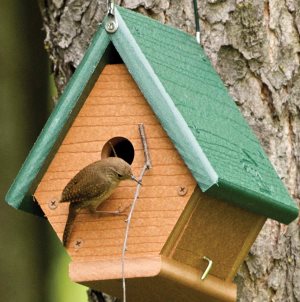
Note: Bluebird lovers have gone to long lengths trying to discourage house wrens from using bluebird boxes.
House wrens will often destroy bluebird eggs, remove them from the nest and then proceed to use the nest box for themselves.
But there has also been documentation of both bluebirds and house wrens living peacefully in coexistence.
Just a note for you to ponder in case your bluebird-loving neighbors go postal on you when they find out you are building a wren house.
But if you want wrens, go for it! Wrens are cool little birds and should be enjoyed too.
More Bird House Plans Tips and Info:
Purple Martin Bird House Plans
How to Build a Wood Bird House
Phoebe, Barn Swallow and Robin Bird House Plans
American Kestrel Nest Box Plans
Making Bird Houses - Construction Tips
What is the house wren diet?
A house wren's diet consists mostly of invertebrates such as caterpillars, flies, millipedes, grasshoppers, moths, spiders, crickets, beetles and snails.
Do house wrens reuse their nests?
If they reuse a nest location, the male house wren will clean out the old material and rebuild.
Most of his time is spent filling the nest with short twigs and some spider egg cases, while the female mostly spends time lining the nest later with soft material like grass and feathers.
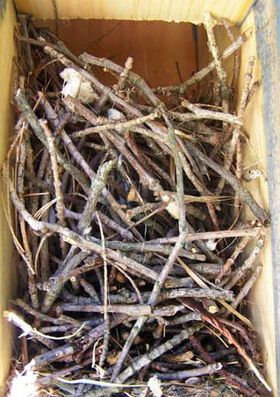
If she doesn't think the male put enough twigs, she may add some. If you want something done right...lol.
Since wren territories are only 1/2 to 3/4 acre in size, if you hear a male wren singing, it's nest is likely nearby.
|
Our Favorite Bird Watching Binoculars, Squirrel-Proof Feeder & Hummingbird Feeder Read Our Reviews: |
||
Nikon Monarch M5
Best mid-priced bird watching binoculars. Waterproof, shockproof, multi-coated ED-Glass. |
|
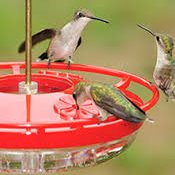
Best Hummingbird Feeder
Drip-Free, Ant-moat, Durable, Easy to Fill and Clean. |
| Click Images or Links To View More Info | ||
Subscribe to Our FREE Newsletter: The Birder Alert!

