
Precautions Against Bird Diseases At Feeders From The National Wildlife Health Center
People who feed birds cannot ignore the bird diseases' issue.
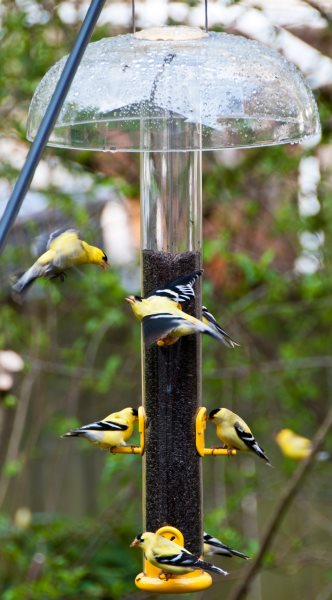
Eight relatively easy steps can be taken to prevent or minimize disease problems at feeders.
1. Give them space - Avoid crowding by providing ample feeder space. Lots of birds using a single feeder looks wonderful, but crowding is a key factor in spreading disease. If birds have to jostle each other to reach the food, they are crowded. This crowding also creates stress which may make birds more vulnerable to disease.
2. Clean up wastes - Keep the feeder area clean of waste food and droppings. A broom and shovel can accomplish a lot of good, but a vacuum such as you might use in your garage or workshop will help even more.
3. Make feeders safe - Provide safe feeders without sharp points or edges. Even small scratches and cuts will allow bacteria and viruses to enter otherwise healthy birds.
4. Keep feeders clean - Clean and disinfect feeders regularly. Use one part of liquid chlorine household bleach in nine parts of tepid water (a 10 percent solution) to disinfect. Make enough solution to immerse an empty, cleaned feeder completely for two to three minutes. Allow to air dry. Once or twice a month should do, but weekly could help more if you notice sick birds at your feeders.
5. Use good food - Discard any food that smells musty, is wet, looks moldy or has fungus growing on it. Disinfect any storage container that holds spoiled food and the scoop used to fill feeders from it.
6. Prevent contamination - Keep rodents out of stored food. Mice can carry and spread some bird diseases without being affected themselves.
7. Act early - Don't wait to act until you see sick or dead birds. With good prevention you'll seldom find sick or dead birds at your feeders.
8. Spread the word - Encourage your neighbors who feed birds to follow the same precautions. Birds normally move among feeders and can spread diseases as they go. The safest birdfeeders will be those in communities where neighbors cooperate with equal concern for the birds.
How To Clean Your Seed Bird Feeders, Hummingbird Feeders, and Bird Baths
The Complete Story
Birds do get sick. Disease is one of many natural processes affecting wild
species. Sick birds do show up at feeders, and other birds can get sick as a
consequence.
Just because bird feeding is not problem-free does not mean that it is bad or should be stopped. It does mean you have an ethical obligation not to jeopardize wild birds. What is called for is intelligent bird feeding. Follow the precautions listed above, and you can continue to enjoy feeding healthy wild birds.
Bird feeding seems like the perfect out-door activity. People can learn a lot while they enjoy helping birds. As ideal as bird feeding may seem, it carries some risk for birds that visit the feeders and some responsibility for people who do the feeding.
Bird Diseases
Four diseases commonly affect those bird species that typically use feeders. This is an important distinction because not all bird species visit feeders.
Salmonellosis (sal-muh-nel-LOW-sis)
Salmonellosis is a general term for any disease in animals and people caused by
a group of bacteria known by the Latin name Salmonella. Birds can die quickly if
the Salmonella bacteria spread throughout the body. Abscesses often form in the
lining of the esophagus and crop as part of the infection process. Infected
birds pass bacteria in their fecal droppings. Other birds get sick when they eat
food contaminated by the droppings. Salmonellosis is the most common bird-feeder
disease.
Trichomoniasis (trick-oh-mo-NYE-uh-sis)
The Trichomonads are a group of protozoan (one-celled microscopic) parasites
that affect a broad variety of animals, including humans. One Trichomonads
species afflicts only pigeons and doves. The popular and widespread Mourning
Dove is particularly susceptible. Birds afflicted with Trichomoniasis typically
develop sores in their mouths and throats. Unable to swallow, they drop food or
water contaminated with Trichomonads that other birds then consume, thus
spreading the disease.
Aspergillosis (as-per-jill-OH-sis)
The Aspergillus fungus (mold) grows on damp feed and in the debris beneath
feeders. Birds inhale the fungal spores and the fungus spreads through their
lungs and air sacs, causing bronchitis and pneumonia.
Avian Pox
More noticeable than the other diseases, avian pox causes wartlike growths on
featherless surfaces of a bird's face, wings, legs, and feet. The virus that
causes pox is spread by direct contact with infected birds, by healthy birds
picking up shed viruses on food or feeders, or by insects mechanically carrying
the virus on their body. However, not all warty growths on birds are caused by
the avian pox virus.
The Disease Problems
All four diseases can lead to death. Salmonellosis may kill the birds outright,
and pneumonia from Aspergillosis is nearly always fatal. Trichomoniasis may
obstruct a bird's throat. Avian pox growths on the face can become large enough
to impair vision or eating ability and growths on feet and toes can affect a
bird's ability to stand or perch. Thus, sick birds are more vulnerable to
starvation, dehydration, predation, and severe weather.
You can spot sick birds in a crowd. They are less alert and less active. They feed less and often cower on a feeder, reluctant to fly. Their feathers look ill-kept. Despite these obvious symptoms, disease usually is overlooked as a complication of feeding birds. Certainly, the signs of illness are not as easily noticed as bright colors and cheery songs; but being inconspicuous does not make disease unimportant.
Enjoy feeding the birds, but please take the 8 steps above to prevent bird diseases at your feeders and help keep wild birds healthy.
More Bird Feeding Pages:
Wild Bird Food - What do Birds Prefer?
Preventing Bird Window Collisions
Bird feeder and Red-bellied Woodpecker photos courtesy of Brady MacDonald
|
Our Favorite Bird Watching Binoculars, Squirrel-Proof Feeder & Hummingbird Feeder Read Our Reviews: |
||
Nikon Monarch M5
Best mid-priced bird watching binoculars. Waterproof, shockproof, multi-coated ED-Glass. |
|
Best Hummingbird Feeder
Drip-Free, Ant-moat, Durable, Easy to Fill and Clean. |
| Click Images or Links To View More Info | ||