
Found a Baby Bird? Here's What To Do
If you found a wild baby bird and it has grown most of it's feathers, can hop around and maybe can even fly a little, it has probably already fledged (a fledgling).
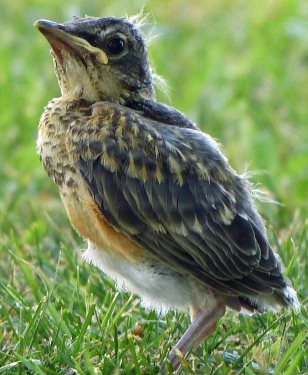
At this stage in its development, it is supposed to be out of the nest and hopping around on the ground, trying to scramble up into small trees.
The baby bird will be able to fly in a few more days and has probably reached full body weight by this time and only needs its tail or wing feathers to grow a bit longer.
Best for the bird if you leave it where you found it and keep your dogs and cats in the house for a few days.
If absolutely necessary (near dogs, cats, small boys or in the road), put the young bird in the shrubs or small tree (though it probably will not stay there) or put it in you neighbors yard if you have animals but they do not.
The baby bird will attract the attention of it's parents, and they will continue to feed it even after it can fly.
In most cases you may think the baby bird has been abandoned, but if you leave the bird alone and just wait and watch, one of the adults will probably come and feed the young bird within a few minutes.
Don't Have This Happen To You
We have received numerous emails from people who have found a baby and/or injured bird and despite our advice, insist on trying to take care of it themselves.
Inevitably, within a few days we usually get a response such as this:
"I'm heartbroken the little bird expired last night, even with all my hard effects to help him live on...and the little thing as lively as he was sitting on my chest passed away, I cried myself to sleep."
Some of these birds, mostly fledging, would have survived on their own and only died because of incorrect care and handling.
I know most people have good intentions, but the best thing to do is to return the bird to a safe place and leave it alone or take it to a wildlife rehabilitator.
Please read below and watch the video about what to do if you found a baby bird for more information.
What to Do if You Found a Baby Bird
From Nestling to Fledgling
Believe it or not, baby birds grow so quickly that they don't spend many days in the nest.
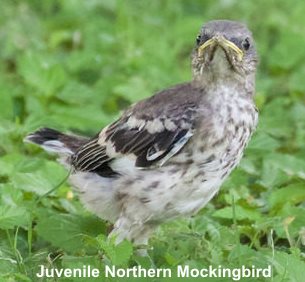
After hatching, common birds like the Northern Mockingbird, American Robin or Northern Cardinal only spend 11 or 12 days in the nest before fledging.
If you disturb the nest after about day 8 or 9, they may jump out then, because they think you are a predator.
Most cavity nesting birds take a few more days to fledge, but almost all altricial passerine birds will fledge by about 20 days.
The largest passerine, the Common Raven takes up to 48 days to fledge.
70% of post fledging mortality occurs during the first 5 days out of the nest.
Mostly because the young birds are on the ground and they are noisy because they beg for food.
Most mortality is due to predation by natural predators (birds of prey, snakes, foxes etc) as well as from dogs, cats and being hit or "run over" by cars or run into windows.
It is surprising how many natural predators still inhabit our urban areas, and recent studies show that densities of some predators (such as raccoons) may actually be higher in urban areas than in more natural habitats.
If the Baby Bird Has Very Little or No Feathers
A wild baby bird is not supposed to be out of the nest if it doesn't have feathers.
It is still a nestling.
If you found a baby bird and know where the nest is, put it back.
If the entire nest has been blown from a tree or bush, put all the chicks back in the nest and put the nest back in the tree and tie or wire it to the tree if you have to.
You can even use a small basket or cup with dry grass to replace the nest.
Don't worry that the adults will smell you and abandon the nest.
The adults have such a powerful instinct to return to the nest and feed the young, that in most cases, they will feed the young in the makeshift nest.
They may have a hard time brooding them to keep the chicks warm at night in the artificial nest if it is not the right size or shape, but they will continue to feed them.
Also, most passerines have a less developed sense of smell.
What to Feed a Baby Bird?
Do not attempt to feed a bird because you could do more harm then good. It is okay if you want to fill a shallow container of water and place it next to the bird so it can drink, but do not force it.
It requires state and federal permits to legally "rescue" or "rehabilitate" or care for "Abandoned" protected birds.
Birds are protected by the Migratory Bird Treaty Act (MBTA) and it is against the law to handle wild birds.
You should know that it is even illegal to possess a bird feather.
Only state rehabilitation permits are required for most mammal species.
You could also find a local wildlife or bird rehabilitation center at the Wildlife Rehabilitation Information Directory.
Other possible options are taking the bird to a veterinarian, humane society, or your state wildlife division.
What Not to Feed to Baby Birds
Many birds eat a variety of seeds and hummingbirds even drink nectar, but that doesn't mean that is all they eat.
This is especially true for baby birds that are still growing in size and/or still growing feathers and so need to be fed mostly protein (even hummingbirds).
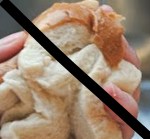 Do not feed tofu or wet bread or dry bird seed or milk* to baby birds.
Believe it or not, these items have actually been fed to baby birds by adult humans and Yes...
You know these stories all had sad endings.
*Pigeons and doves do feed what is known as crop sac milk to their young.
This high protein "milk" is produced in the crops (in their throat) by the adults and the young get the milk when they put their heads inside the adults mouth to feed.
More What Not to Feed to Baby Birds
Hamburger meat has protein, but it has also too much fat which the birds are not able to digest.
I even knew of a situation where a woman found a baby Great-horned Owl and kept it for about 5 years and fed it nothing but hotdogs (the wiener without the bun).
The owl actually seemed to be in perfect health, but that is not the recommended diet for owls.
I Understand It's Illegal, But What Should I Feed a Baby Bird?
If you are still considering feeding the baby bird you found, ignoring all the advice about leaving them alone and are going to attempt to feed them no matter what anyone says, then at least take some time and effort to learn more about what and how to feed them.
However, we still say don't do it.
You should know that it is illegal to try to care for wild baby birds unless you have a federal permit under the Migratory Bird Treaty Act (MBTA).
It is best to call your local wildlife rehabilitation center and let professionals care for the bird if necessary.
If you are going to feed the baby bird anyway, at least be smart about it - and I believe you will since you are taking the time and effort to learn more about what and how to feed them.
Well, it would help to know what species of bird you have and what the adults would be feeding it.
Here are some easy to find high protein choices for feeding baby birds
depending upon the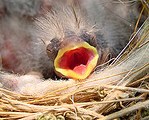 species:
- Earth worms or nightcrawlers
- Crickets
- Mealworms or waxworms
- Canned or Soaked dry cat food
- ZuPreem or Kaytee - fortified nutrional pellet/seed mix for small birds
Keep in mind, the professional rehabilitators usually tube feed baby birds with a blended mixture of their own making. They have years of experience caring for injured or abandoned birds and sometimes they even have losses.
It is not as simple or straightforward as you may think.
An example of the depths you need to be prepared to plunge to take on your bird feeding endeavor, I have fed juvenile raptors (had all the proper permits) with a mush of blended mice that is fed to them from a "baggie".
A corner is cut out of the baggie and the mixture is slowly squeezed out like icing from a piping bag.
I suggest having a special blender for this purpose and do not use the one from your kitchen. Otherwise, whoever you are living with may not appreciate it. ;-)
If you are still interested in taking on the responsibility of feeding baby birds, at least work with an experienced wildlife rehabilitator.
What to Feed Baby Pigeons and Doves
Many years ago, I kept a few homing pigeons.
A pair of birds produced a late (October) brood of chicks, but an early freeze caused the adults to stop feeding the chicks.
By the time I noticed, one chick had already died. I successfully hand fed the remaining chick until it fledged.
The only problem, the pigeon preferred to stay with me than with the other pigeons because it had become imprinted.
It would even fly and walk with we when I walked the dogs and would chase my car down the road for miles and land on the car at when I stopped.
Since it was a homer, it always found it's way back home. Wish I had a picture.
Imprinting is another reason not to had feed wild birds.
If they become imprinted on humans, they have no chance of living a natural life in the wild.
Baby Pigeon Formula
No doubt there are many formulas to feed baby pigeons, but here is my formula:
- 50% cornmeal
- 50% dove bird seed (mainly millet and milo)
- Formulas for human infants (like Similac or Enfamil)
- Apple juice
Make a thick slurry from the cornmeal and ground bird seed (ground using coffee grinder) by adding the soybean milk. Add a touch of apple juice.
My theory was the cornmeal, bird seed, and apple juice provided the needed calories and vitamins, and the soybean milk provided the protein and more vitamins.
The bird was fed with a large eye-droppers and syringes as was fed as much as possible at each feeding and as many times as was possible each day (what a chore!).
Tube feeding the bird would have probably been safer for the bird and faster for me, but I did not know how at the time.
In conclusion, if you found a baby bird the best thing you can do is call you local wildlife agency who will determine whether or not the bird requires additional assistance or rehabilitation by a licensed caretaker.
Here is also general guidelines what to do if you found an injured bird, not necessarily a baby.
What to do with a nestling vs fledgling baby bird if found on the ground
More Tips and Information about Birds:
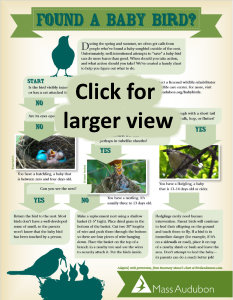
What do you do if you find a baby bird on the ground?
If you find a baby bird on the ground in your backyard, leave it alone unless it is in immediate danger, i.e., your cat is about to attack it.
If it a nestling without feathers, place it back in the nest.
If it is a fledgling with feathers, and is out in the open on a street, or somewhere it can be harmed, or trapped in a window well, etc.. you can place it in a nearby shrub.
The parents will return to feed it.
Don't worry about leaving your scent on the bird.
It's a myth the parents will reject it!
Birds have a poor sense of smell and have a much stronger drive to care for their young.
|
Our Favorite Bird Watching Binoculars, Squirrel-Proof Feeder & Hummingbird Feeder Read Our Reviews: |
||
Nikon Monarch M5
Best mid-priced bird watching binoculars. Waterproof, shockproof, multi-coated ED-Glass. |
|
Best Hummingbird Feeder
Drip-Free, Ant-moat, Durable, Easy to Fill and Clean. |
| Click Images or Links To View More Info | ||
Subscribe to Our FREE Newsletter: The Birder Alert!

