
Bald Eagle Pictures & Information, Webcam
Click on thumbnails below for larger Bald Eagle pictures. Please note our terms of use for using any of the photos from our website.
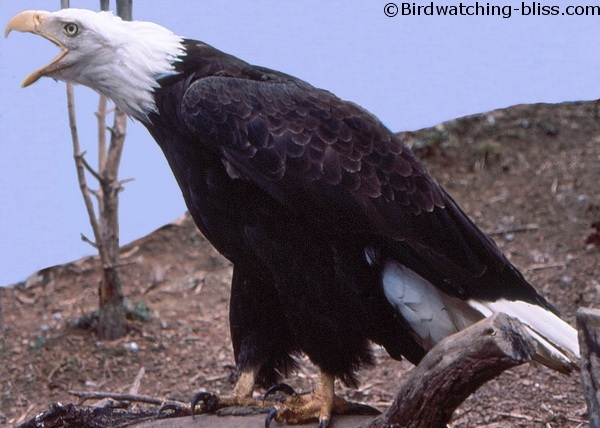
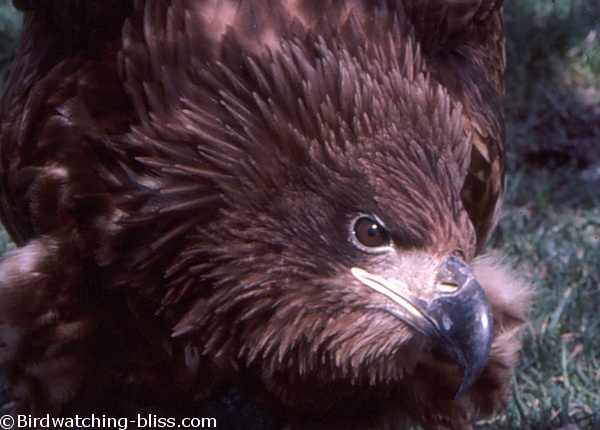
The below photos are an example of an adult bald eagle, at least four years old because of the white "bald" head as well as body plumage. The second photo is of a juvenile bald eagle in its first year plumage, lacking any white feathers in the head and is more brown in color.
Bald Eagle
(Haliaeetus leucocephalus)
 |
|
|
Bald Eagle Adult At least 4th year |
Bald Eagle Juvenile (1st year plumage) |
Click on thumbnails for larger photos. We plan to add more Bald Eagle Pictures in the future.
Bald Eagle Nest Cam
If it is breeding season in Maryland (~January through May), you will likely see either adult bald eagles or juveniles in the nest from the live webcam below.
Live Bald Eagle Webcam
NOTE: The camera will be offline until the next breeding season begins.
 |
If the image stops updating, press the F5 key or exit and re-enter the page.
Above is a live video feed of the Bald Eagle nest at the Blackwater National Wildlife Refuge in Cambridge, Maryland.
Since 2014 the nest has failed. In 2015, another eagle killed the chicks. This type of behavior will likely be more common as the eagle population continues to grow leaving fewer potential mates and nest sites.
The nest failed in 2016 probably due to other eagles intruding on the nesting territory. On Feb. 9 (2016), the female was disturbed while incubating the eggs. The female eagle was obviously aggitated about something (probably an intruding eagle). She stopped incubating the eggs and kept leaving the nest. Neither parent incubated the eggs that night nor into the next morning, so the eggs froze and were no longer viable.
In early 2017, a Bald Eagle pair showed up, but failed to use the nest.
This nest was last successful in 2013 and 2014 and fledged two chicks both years. The nest has fledged at total of 17 chicks since 2005.
Here is another live Bald Eagle Nest Cam in Avon Lakes Ohio.
The video below shows two newly hatched Bald Eagle chicks being fed and brooded by the female.
Bald Eagle Subspecies
There are two recognized subspecies of Bald Eagles. The Northern (Canada/Alaska) subspecies (Haliaeetus leucocephalus alascensis) and the Southern subspecies (Haliaeetus leucocephalus leucocephalus) that breeds in the lower 48 states.
The separation of the two subspecies by whether or not they bread North of South of the Canada/US border is arbitrary.
A.C. Bent (1937) stated that the Southern Bald Eagle probably did not extend North of South Carolina in the East, the Gulf States and Southern California.
The justification of two subspecies is partially based on size differences between Northern and Southern individuals.
True to Bergman's rule, the largest individuals are found in the North and the smallest are in the South.
Bald Eagle Size
Bald Eagles are reverse size dimorphic, meaning that the females are larger than the males.
According to A Photographic Guide to North American Raptors , Wheeler & Clark 1995), The range in Length, Wingspan and Weight as follows: (No sex or sub-specific differences are shown).
Length: 27-35 inches (70-90 cm)
Wingspan: 71-89 inches (180-225 cm)
Weight: 4.4-13.6 lbs (2.0-6.2 kg)
Distribution & Habitat
Bald Eagles are now fairly common breeders around coastlines or large bodies of water in Florida, Chesapeake Bay, Coastal Maine, the Maritime Provinces of Canada, undeveloped areas of the Great Lakes, Yellowstone, Alberta, Ontario, and the Pacific North-West from Northern California to Alaska.
Bald Eagles can be found throughout North America during winter around open water.
Bald Eagle Historical Distribution
Bald Eagles historically nested in Alaska and in all of the lower 48 states. (All states except Hawaii).
In 1963 only 417 nesting pairs were known in the lower 48 states and in 1967, the Bald Eagle was protected by the Endangered Species Act.
The Bald Eagle was listed as Endangered in areas south of the 40th parallel.
Bald Eagles have never been Endangered or Threatened in Alaska.
Bald Eagles were listed as Threatened in Michigan, Minnesota, Oregon, Washington, or Wisconsin, but were never listed as Endangered in those states.
Since 1963, the numbers of nesting Bald Eagles has increased dramatically and in 1995, the status was changed from Endangered to Threatened by the U.S. Fish & Wildlife Service (USFWS).
Bald Eagle Current Status
The Bald Eagle is the National Emblem of the U.S and breeds only in North America.
In 1999, the USFWS proposed that the Bald Eagle be removed from the Federal List of Threatened and Endangered Species.
On Aug. 9, 2007, the Bald Eagle was removed from the federal list of threatened and endangered species.
It was estimated (by USFWS) there were over 9,000 nesting pairs of Bald Eagles in lower 48 states in 2006. ( See number of nesting pairs of Bald Eagles for each State between 1990 - 2006.) That estimate was up from 6,471 nesting pairs in 2000.
Since the Bald Eagle is no longer listed as Threatened and Endangered, there is no Federal mandate to monitor their population. Therefore there are no recent population estimates.
Bald Eagle Migration
Southern Bald Eagles in Florida and the Southern States, can remain near their breeding territories year round, though some birds move Northward during the Summer after the breeding season.
The Northern Bald Eagles and their Southern cousins from the Northern States, migrate South in search of open water.
They can remain in Northern areas where there is open water and an adequate food supply.
Immature birds begin to migrate earlier than adults and also travel farther South.
Bald Eagles can be seen at many Raptor Migration sites: Go to Raptor Migration Page
Bald Eagle Longevity Record
The oldest known wild Bald Eagle lived 30 Years and 9 months. This age was based upon known age of the eagle at banding and subsequent band recovery (Data from Bird Banding Lab (Klimkiewicz 2008).
Bald Eagle References:
Bent, A.C. 1937. Life Histories of North American Birds of Prey, Order Falconiformes. Part 1. Smithsonian Institution United States National Museum Bulletin 167: 321-333
Klimkiewicz, M. K. 2008. Longevity Records of North American Birds. Version 2008.1. Patuxent Wildlife Research Center. Bird Banding Laboratory. Laurel MD.
Technical Note. Bureau of Land Management - Dept. of Interior. Habitat Management Series for Endangered Species. Carol Snow. Report No. 5. Southern Bald Eagle (Haliaeetus leucocephalus leucocephalus) and Northern Bald Eagle (Haliaeetus leucocephalus alascanus).
The video below shows a Bald Eagle catching fish in slow motion.
Related Bird of Prey Pages:
Golden Eagle Pictures and Information
|
Our Favorite Bird Watching Binoculars, Squirrel-Proof Feeder & Hummingbird Feeder Read Our Reviews: |
||
Nikon Monarch M5
Best mid-priced bird watching binoculars. Waterproof, shockproof, multi-coated ED-Glass. |
|
Best Hummingbird Feeder
Drip-Free, Ant-moat, Durable, Easy to Fill and Clean. |
| Click Images or Links To View More Info | ||