
Free Bird House Plans
Bluebirds, Purple Martins, Wrens, Ducks & More
"Why are there so many different bird house plans?"
Many bird house plans are species specific and for good reason.
For example, cavity-nesters require different entry-hole diameters.
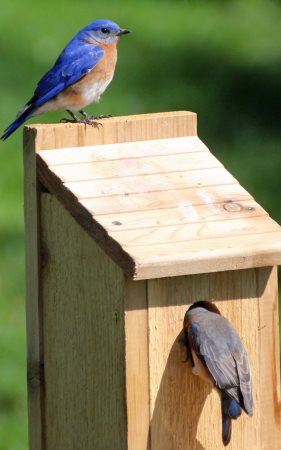
A hole size for bluebird house plans will be different than one for chickadees.
There are even different recommended hole sizes for each species of bluebirds such as Eastern, Western and Mountain Bluebirds.
This chart has bird house dimensions and hole sizes for 34 species.
It is also important to make the appropriate size hole because it will exclude certain undesirable species.
For example, a hole size 1 1/8 inch in diameter will exclude starlings and house sparrows, which often monopolize nest boxes and even evict more desirable species.
So it is important to choose the appropriate bird house plan for the species you wish to attract.
We have made a collection of free bird house plans for general and species-specific nest box plans for you to use to build your own bird houses.
How To Build A Bird House Video
This is a more elaborate design, but gives you a quick look at one type of bird house design. View our birdhouse plans further below for an easier to build box.
Approximately 1 dozen cavity-nesting birds will use boxes with a 1 1/2" entrance hole.
These include Tree & Violet-green Swallows, bluebirds, chickadees, wrens, nuthatches, and possibly titmice.
Wrens will use holes that are smaller than 1 1/8" in diameter.
Woodpeckers will prefer larger holes, 2 1/2" across.
Free Bird House Plans
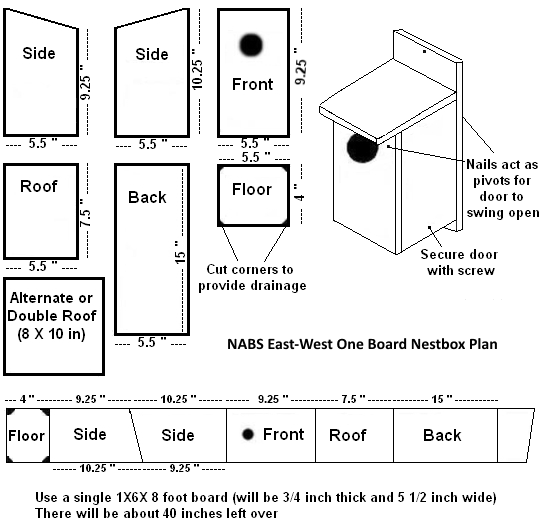
Below is a one-board bird house plan from the North American Bluebird Society (NABS) that will attract a variety of birds to nest.
Bluebird House Plans
Here are bluebird nest box plans (pdf) that are fairly simple, you make all your cuts out of one 1"x6"x4' board.
The plans can be used to attract either Western or Eastern Bluebirds.
If you live in an especially hot climate, like the South, here are cooling bluebird house plans designed to draw air in and keep nestlings cool on hot days.
We aslo have more information and plans on our bluebird house plans and Eastern Bluebird pages.
Wren House Plans
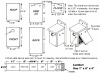
Very similar to bluebird houses, the wren house plans are also made from one 1"x6"x4' board.
Mounting location will be different as well as hole diameter size.
You can read more about the wren next box plans by following the link above.
Purple Martin Bird House Plans
As you may already know, when building a bird house for Purple Martins, you are not building for one pair, but rather for several to many pairs of birds because Purple Martins are colony nesters.
You are essentially building an apartment complex that consists of several units or rooms for each pair of birds.
You can also use gourds that are hung together instead of building a house.
Here are purple martin plans for 1-level, 8 rooms (pdf file).
We have additional information on our purple martin bird house plans and gourd birdhouses pages.
Barn Swallows, Phoebe and Robin Bird House Plans
Robins, phoebes and barn swallows are not cavity nesters so instead of a closed-in house, they rather prefer to nest on shelf or platforms with the front being completely open.
They can be 4-sided, with a floor, 2 walls and a roof or if you have a sheltered area, like under an eave or porch, you can just build an open platform with no walls or roof.
Here are robin nest shelf plans made easily from one 1"x10"x4' board.
More free plans can be found at Phoebe and Robin nest box plans.
Will Hummingbirds Use A Birdhouse?
Hummingbirds do not use birdhouses as they prefer to build their nests on the branches of trees and shrubs and not in enclosed tree cavities - or in equivalent enclosed bird houses.
However, if you are interested in attracting hummingbirds to your yard, you can provide them with a source of nectar by setting up a hummingbird feeder as well as planting their favorite flowers.
Making Bird Houses - Construction Tips:
Size of Nest Box Matters
If the box is too small, the birds will not use it or it may become so crowded as the young grow.
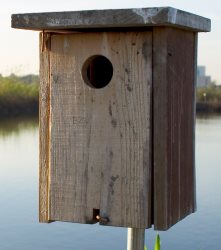
They may not be injured, but a crowded box is hard for the adults to keep clean and it is more difficult for chicks to stay cool.
It is possible that young are forced to fledge prematurely.
Some believe that larger boxes help the birds exercise more, so they are more capable of flying when they fledge.
If the box is too large, the birds may not use it because it is too vulnerable to predators or it may attract too much attention or be difficult to support.
Bird House Roof
Every nest box needs a roof (though many natural cavities are open on top).
Our choices are fairly simple.
Flat or a sloping; overhang or flush.
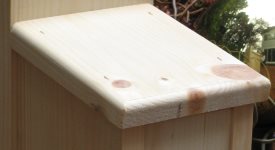
It appears that in most cases (there are lots of nest box designs) that 1 inch overlap on the sides and 2 inch overlap in the front is adequate for protecting the occupants from the elements (rain) and increasing the boxes longevity by keeping the box dry.
Another main function of the roof is to provide shade for nest boxes that are exposed to the sun, especially in warm climates.
So the roof should be sloped to help water runoff (as close to 45 degrees as possible), and it should be overlapped to let water drip away from the box and to provide more shade.
If you plan to place your box in the open (bluebirds for example) in a warm area, you should consider a double roof to keep the box cooler.
The two roofs should be spaced to allow air to circulate between them. It has also been suggested that a second side wall be added to also shade the west side of the box.
Front of Nest Box
Most nest box plans have a perpendicular face,
but recently, several designs have a sloping front.
The advantages:
- Easier for young to escape from the box
- Protects entrance holes better from wind and rain
Disadvantages:
- Difficult to mark and cut and
- Increases scrap wood
What kind of Hole for the Nest Box? Round, Oval or Slot? One hole or two?
Believe it or not, several bird house designs have more than one hole.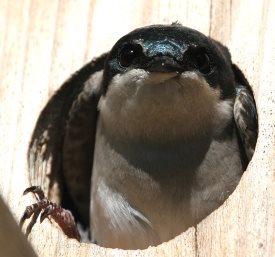
Advantages?
Both adults can feed young at the same time - one adult doesn't have to waste energy & time flying around.
A second hole may prevent the strongest chick from dominating access at the entrance hole.
Also, if predators or house sparrows get in the nest, at least the adults have a chance to escape through the second hole.
If ventilation is an issue, the second hole also acts as a big vent.
Well, at least I have convinced myself... the next box I build or modify will have two entrance holes.
Disadvantages - May allow easier access by predators and weather (rain).
Some of the research seems to indicate that Bluebirds are attracted to the oval hole (more than the Peterson box shape).
There are conflicting data about the slot hole design and access for house sparrows.
Some say the slot entrance discourages house sparrows and others have found that house sparrows readily use them.
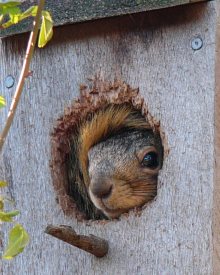
If you have trouble with squirrels, then make sure you install a hole guard or restrictor to prevent squirrels from chewing the entrance hole larger.
Squirrels will kill and eat nestlings if they get access.
Bird House Building Materials
Wood
The building materials don't necessarily have to be wood.
I guess we could use the recycled plastic material that is being used for decks and fences.
Nest boxes can also be made from PVC pipe or plastic buckets, but those are different plans to be covered later.
What Kind of Wood?
If you have access to redwood or cypress or even cedar, that's great.
Those types of wood will last a long time, but they can be expensive.
Hardwoods will last longer than soft woods, but they can also be expensive.
Treated or Untreated Wood for Nest Boxes?
Treated wood (softwood) will last longer.
But is treated wood safe to use for bird houses?
The EPA website says treated wood is safe to use in vegetable gardens and on picnic tables, but it is not safe to use on cutting boards, counter tops or bee hives.
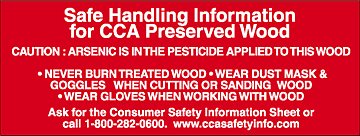
CCA treated (Wolmanized). This material was stopped from use in residential construction in 2003, Canada.
I have seen web sites that claim treated wood releases "dangerous fumes" and should not be used when making bird houses.
They do not cite the source of this information.
Another website says that only untreated wood should be used in case the birds "gnaw" on the wood.
Except for parrots, birds are not generally known for gnawing, but they do peck at the wood (That is how woodpeckers and chickadees excavate their nest cavities).
The Purple Martin Conservation Organization recommends:
"Only untreated wood (no pressure-treated wood, no chemically-treated wood, etc.)" when making bird houses.
Conclusion About Using Treated Wood
Since birds are well known to be very sensitive to environmental pollutants (remember the canary in the coal mine?), let's not take any chances.
Only use untreated wood.
Nest Boxes can be made from solid wood stock, plywood, bark slabs or solid logs
Many of the nest boxes I built in the past were made of plywood, because I always had scraps of plywood handy.
Many plans recommend using plywood (exterior grade plywood) and some even preserve the wood with spar varnish.
Nest boxes can also be built by using exterior slabs (slab lumber) that still have the outside tree bark when the tree is sawn up to make lumber.
Birdhouses from Logs
Solid logs can also be hollowed when making bird houses.
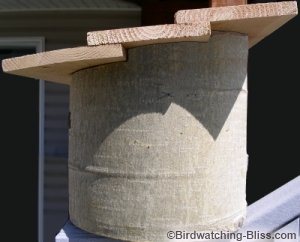
I have done this by first splitting the log, then hollowing out each side, drilling an entrance hole, then joining the two halves back together with wood glue and screws.
The log bird house pictured on the right was not split, but hollowed out.
How to Build a Bird House
from a Tree Log
I have been planning to build a bird house or nest box from a real wood tree log for several years.
I like the way they look and the extra thick walls insulate the birds from heat and cold.
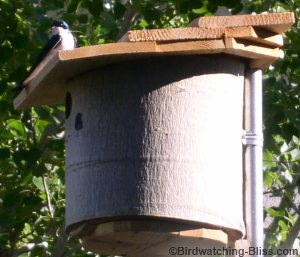
I had been looking for a nice 10-12 inch log, so when we found a fresh fallen 10 inch aspen near our campsite two years ago, I knew I found the right log.
Video of Mounted Bird House with Tree Swallows Using It
We don't have the best video camera and we didn't want to get too close and end up disturbing the nesting tree swallows since they were so nice to choose and use our birdhouse :-), but here is a quick summary video of of the aspen tree bird house:
Aspen Log Nest Box
I didn't want to split the aspen log, because I like the way the bark looks and didn't want to mark it up or have it fall off the log.
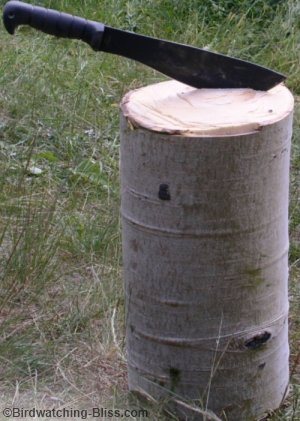
I chopped a two foot section from the downed tree with the idea that I could make two nest boxes.
The birds most likely to use the nest log at our house were Tree Swallows.
They had successfully nested for several years in a nest box attached to the down spout on our front porch.
As the trees in the front yard grew, there seems to be more competition from house sparrows.
A female Tree Swallow as actually killed several years ago in the box.
We assume the house sparrows were responsible.
The new aspen nest log was going to be mounted in the back yard, where there was more open space.
Tree Swallow Bird House Requirements
Since Tree Swallows commonly nest in bluebird houses, many people assumed the two species need the same size box.
Wrong.
According to the Tree Swallow Projects website, a Tree Swallow nest box should have a minimum floor space of 5x5 inches and a depth from the hole to the floor of 7 inches.
A growing brood of Tree Swallows becomes too crowded in the small bluebird nest box and that reduces their nesting success.
They can and will use a small box if nothing else is available, but more nestlings survive if the box is bigger.
Area of Round vs Square Nest Boxes
If the recommended floor space of a tree swallow bird house cavity is 5x5 inches or 25 square inches, what size log is needed to create a cavity with the same area?
Yes, you can actually use some of the that math you learned in school.
- The formula for the area of a circle is Pi r
2 - Pi=3.1416
- r = the radius of the circle, which is 1/2 the diameter
- So, the area of a circle = 3.1416 X r X r
If my log was 10 inches diameter, then the radius was 5 inches. If I left two inches of wood all the way around, the radius of the open cavity was 3 inches.
- Area of a circle with 3 inch radius =
- 3.1416 X 3 X 3 = 28.27 square inches
- About 15% larger than the 5x5 square nest box
The nest log was still very heavy with two inches of wood left around the edge of the log, so I thinned it down to 1 1/2 inches.
Our houses are built with 2x4 lumber, which is 1 1/2 inches thick, so that should be plenty thick for a bird house.
After I took another 1/2 inch off the nest log, it was lighter and still plenty strong.
This also added 1/2 inch to the radius of the open area inside.
The final cavity area of the nest log was
- 3.1416 X 3.5 X 3.5 = 38.5 square inches
- About 54% larger than a 5x5 box
I hoped that would not be too large.
What Size Nest Log is Needed?
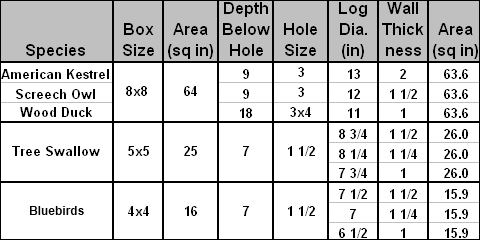
If you are considering making a nest log, I calculated the size log needed to create the minimum cavity area required for several cavity nesting bird species.
Table 1 shows the recommended nest box sizes for three sizes of nest boxes and for five species of birds that commonly use nest boxes.
Table 1. Minimum Log Sizes for Various Bird Houses by Species
Replace 8x8 Nest Box with 11-15 inch Log
American Kestrels, Screech Owls and Wood Ducks need nest boxes at least 8x8 inches.
This area totals 64 square inches of space.
That minimal size requirement can be met with logs between 11-13 inches diameter with wall thickness between 1 and 2 inches.
A 14 and 15 inch log with a 2 inch thick wall would be 78.5 and 95 square inches respectively, or 23% and 49% larger than an 8x8 inch nest box.
Replace 5x5 Nest Box with 7 3/4-10 inch Log
The minimum requirement can be met with logs as small as 7 3/4 inches if the thickness of the wall is reduced to one inch.
If the nest log wall is 1 1/2 inches thick, the minimum requirement is met with an 8 3/4 inch log.
You have already seen that the nest log we used for Tree Swallows was 10 inches and a 3 1/2 in radius cavity was created for an area of 38.5 square inches, or 54% larger than the 5x5 nest box.
Replace 4x4 Nest Box with 6 1/2-9 1/2 inch Log
The small 16 square inch cavity required for bluebirds could be met with logs as small as 6 1/2 inches if the thickness of the wall was cut down to 1 inch.
Keep in mind, these are minimal areas.
A little bit bigger may be better, but too much bigger may not be what the birds are searching for.
Also, part of the reason for using a log instead boards is the thicker walls which provide better insulation.
If we create nest logs with very thin walls, we loose the extra insulation.
A 9 1/2 inch log with a wall thickness of two inches creates a cavity space of 23.8 square inches, or 48% more space than the 4x4 nest box.
Hollowing the Bird House Log
It might have been easier to hollow out the log while it was still green, but I basically left it in the garage for several months.
By the time I started to work on the log, it had lost several pounds of water weight.
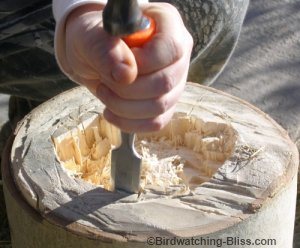
I originally planned to hollow out the log with a chain saw, but I just started chipping away at the log with a chisel one day while enjoying a warm late Winter day in the Sun.
It became more of an afternoon relaxation ritual than a job.
On nice days, I would take 30 minutes breaks from whatever I was doing, go to the back yard, sit in the Sun and chip away at the log.
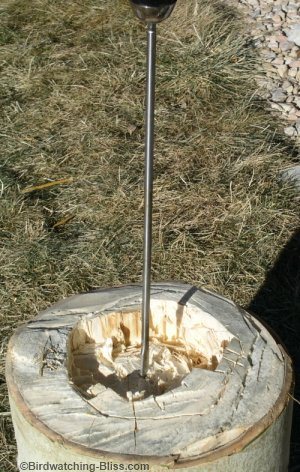
For those of you that believe in karma and positive energy and that sort of thing, except for the occasional smashed thumb, I was putting all kinds of good vibes into the box.
You could say I was wasting time, but I like to think I was being very productive while half-snoozing in the sun.
Just don't snooze too much with a hammer and chisel in your hand.
I also used a very long (x inch) drill bit to drill holes from one end of the log to the other.
Then I alternated between the chisel and the drill depending on which method was more productive.
I used the chisel to smooth out the roughest sides, but don't make it too smooth, so the fledglings can grab onto the sides when they scramble out.
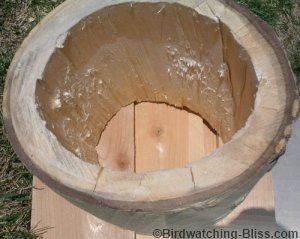
When the nest log was close to being finished, I cut the log in half, thinking I could build two nest logs.
Needless to say, if you use a chainsaw, be very careful, not only of your fingers and toes, but a single slip would ruin the nest log.
If you have a lathe, you would hollow the log as if making a bowl.
A slight rounded bowl shape would be perfect for the bottom and would only need a few drainage holes.
Bird House Roof
In addition to the overlapping shingle roof I used, there are many ways to put a roof on a nest log.
The Figure below has a few examples of roofs I have seen on nest logs.
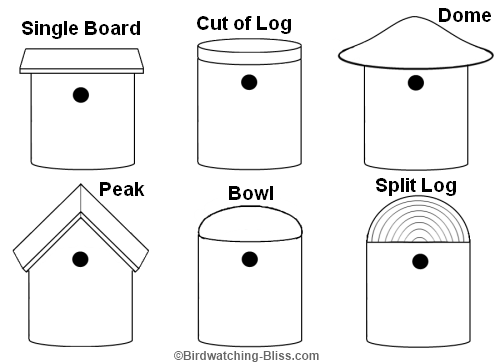
- Single flat board; sloping or flat
- Cut or Slab from the same log placed on top; sloping or flat; overlap or flush
- Shaped wood or metal dome
- Peak or Pitched roof; two boards or overlapping shingles
- Bowl shaped piece of wood; overlap or flush
- Split log with bark still attached; overlap or flush
I chose to overlap cedar shingles that were made from inexpensive cedar fence pickets.
The boards are 5 1/2 inches wide and 6 feet long.
Since the log to be covered was 10 inches wide, I cut 14 inch lengths of the cedar fence picket so the roof would lap 2 inches over on each side.
The 12 inch sections were overlapped by 1 1/2 inches, glued and tacked together. This creates a roof 13 1/2 inches from front to back, which overlaps 1 1/2 inches in front and back.
Next, I shaped the top of the nest log to match the shape of the roof.
Then glued and tacked the roof to the log.
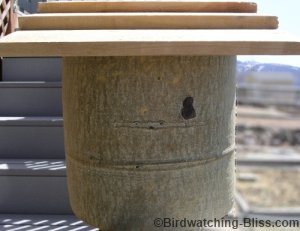
I like the final look and function of the roof on the log box, but I did not think it out very well before hand.
The cuts I had to make to fit the roof, especially with the slope, made the box shorter than I originally planned.
Nestbox Floor
It is simple to slap something on the bottom, but it is difficult to cut a close fitting circle to recess inside the log.
After I shaped the top to match the roof, I realized that the nest log barely had the minimum 7 inches from hole to floor.
Because the birds have more space than recommended, it probably doesn't matter if the depth were 6 1/2inches instead of 7 inches, but I chose to simply attach the floor on the outside.
It is not as nice to look ate, but it is functional. The floor is held with screws.
At the end of the season, the floor is removed and the old nest is cleaned out.
Bird House Hole Size
The hole size recommended for Tree Swallows is between 1 3/8 - 1 1/2 inches.
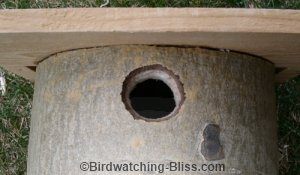
I think it is a good Idea to keep the hole as small as possible, but after watching the Tree Swallows struggle to squeeze through the 1 1/2 inch hole, I expanded and re-shaped the hole.
It is one thing to be able to squeeze through a small hole in a thin 3/4 inch wall, but it is more difficult to squeeze through the same size hole in a 1 1/2 inch thick wall.
After the birds left the box, I spent 3 or 4 minutes and quickly re-shaped the hole with a wood file, so it was wider at the front and back of the hole, but left the middle of the hole at 1 1/2 inches.
After that, the birds still had to squeeze through the whole, but it was obviously easier for them.
Mounting the Bird House
There are a variety of ways to mount nest boxes.
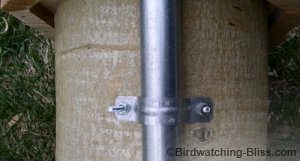
I used 1 inch aluminum electrical metallic tubing (EMT conduit) for a mounting pole.
The conduit was attached to the box with a conduit strap and two bolts.
To make sure the box did not slide down the pole, the roof rested on top of the conduit and I also attached a wooden block to the conduit with a hose clamp to hold the bottom of the log.
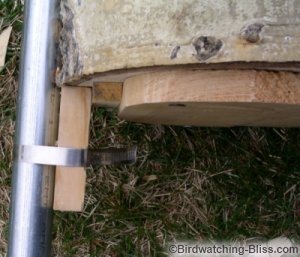
I used a simple method of driving a 5 foot section of a 1/2 inch rebar about 3 1/2 feet into the ground.
The conduit simply slides over the portion of the rebar that is above ground.
Several large rocks are used to support the pole at the bottom to reduce motion and to keep the pole straight.
Nesting Success
The whole point of this is to provide nest boxes for beneficial birds.
It is good for us because we get to enjoy watching them and they also eat thousands of insects.
It can also be educational to watch them as they spend hundreds of hours working to build their nests and to raise their young.
Building nest boxes are also good for the birds. A good nest box mimics natural cavities which are usually in short supply, especially in developed neighborhoods.
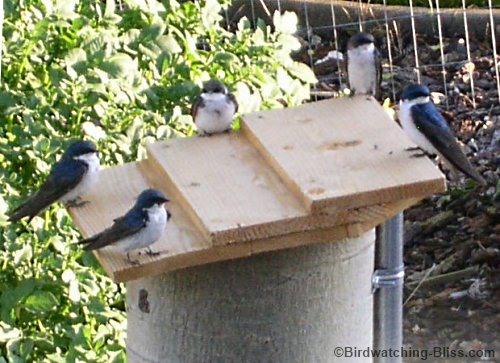
Within hours of mounting the box on the pole, the Tree Swallows were checking it out and at least two pair of birds fought over the box for several days.
There were at least four young fledged from the nest that year. They only hung around for a day or two after they fledged, and it was very confusing when other adults and possibly other young birds came to the box.
A Simple Log Birdhouse
I made several log bird houses when I was a kid. They were made from tulip poplar and pine logs that I spit into quarters, as if splitting firewood.
The middle part of each quarter was chopped and shaved down with a hatchet, leaving the top and bottom untouched.
I reattached the four quarters with glue and a couple of screws.
These nest boxes didn't need an additional roof or floor.
I simply drilled a few drain holes in the bottom and an entry hole on the side.
They hung in the trees in my parents yard, where they were used mostly by Carolina Chickadees.
Thick or thin wood stock for Nest Box?
When making bird houses, the thickness of the stock determines the thermal
insulation of the next box.
It can get cold in the Spring and always gets hot in the Summer sun.
A one inch thick box will protect eggs and young from temperature extremes more than a half-inch thick box.
This doesn't mean that a half-inch box is useless (I have a half-inch thick blue-bird box that fledges 3 or 4 tree swallows most seasons).
Thicker stock is also heavier and more expensive than thinner stock, but it will also create a sturdier box if constructed properly.
Any stock thickness between one-half in up to one inch should be acceptable for a nest box.
If your area is notorious for cold nights in the spring or if your nest box is to be placed in full sun (with no shade), you may want to go with thicker stock or to provide more shade, use two layers of thin stock with spacers between them for roof and west side.
Smooth or Rough Wood for Nest Box?
We all like the feel of a smooth sanded wood, but the truth is, the birds benefit from a rough surface.
A rough surface helps the adults to cling to the side of the box when bringing the nesting material and when feeding the young.
It also helps the young scramble out of the box when it is time to go.
Rough up or score the wood inside the hole so the chicks can scramble out.
Many Wood Duck plans recommend that a "ladder" be made from welded wire or scored into the wood.
Perch or no Perch on Nest Box?
If rough wood helps the birds to "hang on", wouldn't it help to add a perch?
It probably would... but it also helps cats, raccoons, snakes and other nest predators to hang on to the perch while they fish around inside for something to eat.
We recommend not putting a perch on your bird houses.
The birds don't need it and it just makes it easier for predators to get inside the box.
Habitat and Placement
Birds nest in different habitats. So if you place your house in an open field, you are more likely to attract bluebirds or swallows.
If you place your house in a more wooded area, you are more likely to attract chickadees or nuthatches.
So if you want to attract a certain species to your box, keep in mind their natural habitat when looking for a location.
Placement is also important.
Your bird house site should not be surrounded by thick foliage, as parents need an open flight path to and from the nest.
All locations should have an abundance of food, protective cover, and water.
Don't put a perch on the nest box. This makes it easier for raccoons, squirrels, cats and other predators to reach inside.
In general, bird houses should:
- Be several feet off the ground
- Face away from prevailing spring winds
- Have an angled front to prevent rain from entering the hole
The roof or one wall should be hinged, so the box can be opened and cleaned after use, and there should be small drainage holes in the bottom.
Wooden Bird Houses, Long Lasting and Safe for Birds
Wooden bird houses come in a variety of sizes and designs to attract a wide variety of species to nest in your backyard bird house.

Some essential design attributes that a bird house should have includes:
- Drainage and ventilation holes
- A secure hinged door that can be opened for cleaning, monitoring and...
- Locked to prevent easy access by predators or mischievous little boys. ;-)
Types of Wood That Are Best For Birdhouses
The wood type that is best for building your bird house is either red cedar, bald cypress, or redwood because of their natural weather resistance and durability, but any hardwood or softwood would be fine as well.
The wood should be at least 3/4 inches thick to provide insulation from heat and cold.
It is also best to buy wooden bird houses that are made from untreated wood that is not coated with any kind of chemicals.
What About Painting The Bird House?
If you want to paint your wooden bird house, make sure to use a water-based exterior latex paint and it is a light color to reflect heat - not black, dark blue or red, etc..
Bird House Size and What About Perches?
Don't buy a nest box that is too small.
Make sure the floor size is at least 4x4" and the height is at least 5" so that the house is large enough for adults to maneuver and feed young and the nestlings have enough room for development.
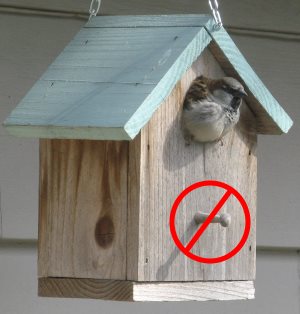
If your bird house has a perch, remove it. Birds do not need it and it just invites aggressive birds like House Sparrows to take over the bird house.
We have more tips about nest boxes at Bird house dimensions chart - which includes appropriate sizes for entrance holes by species.
Look for wooden nest boxes made from quality wood construction, are easy to maintain and have high durability.
Entrance holes size will vary; these pictured below are big enough for wrens, chickadees, nuthatches, bluebirds among a variety of other species (click on photo or link below to view more information):
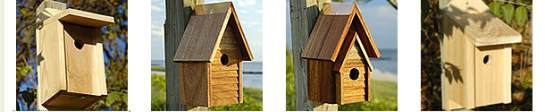
Hope you find a wooden bird house that will attract your favorite backyard birds and be successful in producing a new crop of bird youngsters.
Enjoy viewing the bird cycle of life!
Unique and Fancy Bird House Design
I always think simpler is better, but some woodworkers like to make really elaborate and fancy birdhouses.
That's okay if that's what you want, but the bird house in the video below is
way over the top, don't you think?!
Keeping Predators Out of Your Bird Houses
If you mount a box on a pole, tree, or post, the same predator guard devices used for bird feeders should be included.
Some examples of predator guards are cone baffles or metal/PVC sleeves around the pole, tree, or post the house is mounted on.
Many use them to keep squirrels out of their feeders, but they can also be used to keep predators from climbing up and into the nest box.
There are also baffle blocks or Noel wire raccoon guards that can be placed around the entry-hole.
Metal Bird House Predator Guards
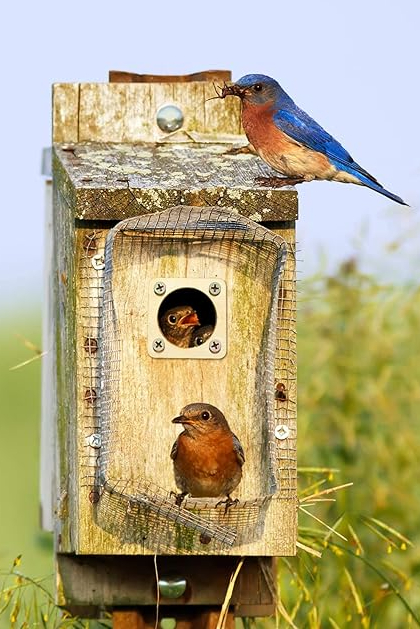
Bird House Hole Guard
More information about installing a bird house entrance hole guard protector or restrictor to prevent
squirrels or other animal predators from chewing the entrance hole to a larger size, allowing access to the adults and nestlings.
Not All Birds Use Bird Houses
Some birds will not nest in bird houses. Only cavity nesters will use next boxes because they nest in natural cavities, such as in dead trees that are hollow inside.
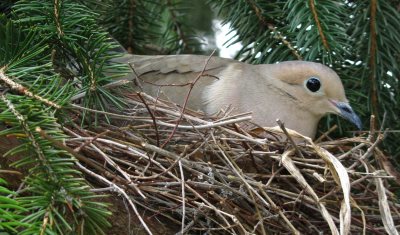
Birds that build nests, for example, in between the branches of trees or shrubs such as goldfinches, cardinals, and doves, will not use a bird house.
You can attract robins and phoebes by providing them a nesting shelf or platform.
This is a tray-like ledge with a roof, attached to a tree or the side of any kind of structure, like under the eave of your house or porch roof.
Similarly, Barn Swallows will use an unroofed shelf under the eave of a building.
Wooden strips nailed under the eave on the outside of a barn or other large building in the open will make it easier for cliff swallows to attach their nests.
After the nesting season is over, knock off the swallow nests, so that each pair will build a new one.
This avoids occupation by house sparrows before the swallows return.
Bird House Plans By Type
Choose the appropriate link below for specific free bird house plans:
Bluebird
House Plans
Variety of plans for Eastern, Western and Mountain bluebirds.
Bluebird House Plans #2 -Hot Weather Design
This bluebird house design keeps eggs and nestlings cool on hot days.
Robin & Phoebe Bird House Plans
Nest Shelves and platforms for Robins and Phoebes.
Wren House Plans
For house wrens, Carolina wrens and Bewick's wrens.
American Kestrel Nest Box Plans
Classic kestrel next box design with tips on construction.
Bird House Dimensions Chart
For 34 species; chickadees, hawks, owls, wrens, nuthatches, more.
If you like to build in general, then you probably would enjoy these 14,000 woodworking plans that includes bird house plus many more building projects for furniture and more.
Duck Bird House Plan
Wood duck, Barrow's goldeneye, common goldeneye, hooded merganser,
common merganser
and bufflehead are all cavity nesting ducks.
Winter Bird House Plans - Provide a winter bird roost or shelter to keep birds warmer during the winter months.
Cornell's All About Birdhouses
Features of a good birdhouse, building the right bird hosue, tips on nest box placement, dealing with predators and more.
Purple Martin Bird House Plans
Purple martins nest colonially in martin apartment houses. Bird house plans for martins vary from very simple to quite elaborate.
Gourds may be used for martins as well and are very popular in the south.
Hard shell gourds are members of the species, Lagenaria, also called bottle gourds.
They can be suspended from crossbars on a tall pole.
Purple Martin Bird House Plans
Multi-level, multi-rooms designs for Purple Martin colonies.
Gourd Birdhouses - How to grow gourds and how to dry gourds in order to make gourd birdhouses for purple martins or other cavity-nesting birds.
Also birdhouse gourds for sale and seeds.
If you want more species specific designs, such as for bluebirds, purple martins, wrens, robins, chickadees, owls or others, then view our bird house dimensions chart.
Bird House Plans FAQs
Should a birdhouse have a perch?
No, don't install a perch on your bird house. Birds that nest in natural cavities don't need them and can easily cling to the outside of the hole entrance.
A perch just gives a predator an opportunity to invade the house.
What is the best wood for a birdhouse?
Cedar, cypress, and redwood are all good choices as well any kind of hardwoods.
Soft woods are fine if you have no other choice, but they will not be as weather resistant and may rot and not last as long as the other aforementioned wood types.
Do not get any wood that is pressure or chemically treated.
Bird House Designs
There are many types of bird house designs that you can use to build your own backyard nest box.
Which should you choose?
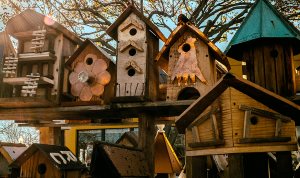
That partly depends on your goals. Do you want something that is more for decoration and if any birds use it or not, that would be just a bonus?
Or do you want to specifically attract certain species of birds to use your bird house such as bluebirds?
If the former is what you want, then any design would do.
If the latter is more of what you are thinking of, then the bird house design you choose is very important in determining which birds do or do not use your next box.
Birds will not care what color your bird house is, whether it has intricate carved designs or cute little welcome signs.
Those elements are for us.
Birds ultimately want a nest box that will shelter them and their eggs and nestlings from weather and predators.
Bird House Design Elements
A bird house's location and placement is also a factor. Hole size and dimensions of the bird house will also play a role in determining which birds will nest and which will not.
Most bird houses will have the basic elements of a sloped roof, floor and four walls - one with an entrance hole. It is also always nice to have one of the side walls lift up on a pivot for cleaning and monitoring.
There should also be holes for drainage and the wood, if used, should be untreated and thick enough to provide insulation both from cold and hot temperatures.
You may also need to install some type of predator guard, such as a baffle, to keep unwanted guests like raccoons, cats or snakes from entering.
Tips for Making Bird Houses and Nest Boxes with Basic One-Board Plans
Making bird houses is a great activity for the entire family.
It provides birds with additional nesting opportunities and gives you unparalleled bird watching opportunities.
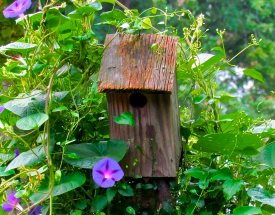
There are a tremendous variety of nest boxes designs. They come in all sizes and materials.
But let's think a minute about why we want to build a bird house and what we hope to accomplish.
Reasons for Building a Bird House
- Increase Potential Breeding Sites for Cavity Nesting Species
- Attract Target Species to Your Property
- Educational Opportunity
- Photography
Goals for Improving a Nest Box
- Improve Nest Box Occupation by Target Species
- Improve Fledging Success of Nestlings
- Reduce or Eliminate Problems from Predators
- Reduce or Eliminate Nesting Attempts by House Sparrows or Starlings
- Improve Longevity of the Nestbox
- Improve access for Monitoring and Cleaning of the Nest Box
Photos of Bluebird house and Mourning Dove courtesy of ptgbirdlover and Katie Tegtmeyer, respectively, at flickr. Bird houses photo courtesy of Sonny Abesamis
|
Our Favorite Bird Watching Binoculars, Squirrel-Proof Feeder & Hummingbird Feeder Read Our Reviews: |
||
Nikon Monarch M5
Best mid-priced bird watching binoculars. Waterproof, shockproof, multi-coated ED-Glass. |
|
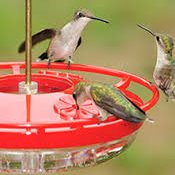
Best Hummingbird Feeder
Drip-Free, Ant-moat, Durable, Easy to Fill and Clean. |
| Click Images or Links To View More Info | ||