
NORTHERN GOSHAWK
(Accipiter gentilis)
The Northern Goshawk is North America's largest Accipiter (about the same size as a Red-tailed Hawk). Goshawks breed in North America from the forested areas of the Northern U.S. and most of Canada, and South into Arizona and New Mexico in forested mountain areas.
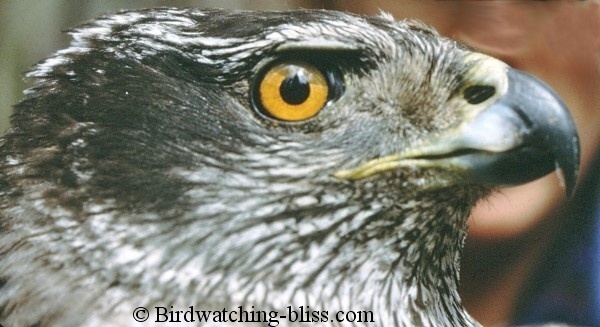 As noted in the Accipiters page, Goshawks are reverse size dimorphic, meaning that
the females are larger than the males. Click on photo for larger image.
As noted in the Accipiters page, Goshawks are reverse size dimorphic, meaning that
the females are larger than the males. Click on photo for larger image.
Northern Goshawk Male and Female Measurements
Length:
Males: 18-20 inches (46-51 cm)
Females: 21-24 inches (53-62 cm)
Wingspan:
Males: 38-41 inches (98-104 cm)
Females: 41-45 inches (105-115 cm)
Weight:
Males: 677-1014 grams (24-36 oz)
Females: 758-1214 grams (26-43 oz)
(above data from
A Photographic Guide to North American Raptors
 ,
Wheeler & Clark 1995). We highly recommend this book for anyone interested in raptors.
,
Wheeler & Clark 1995). We highly recommend this book for anyone interested in raptors.
The Video below shows how a Northern Goshawk chick develops over time.
For Northern Goshawks, there are some overlap for individual measurements of Wing Chord, Tail and Weight between the sexes, (Unlike Sharp-shinned Hawks or Cooper's Hawks). There are also measurable differences between juvenile and adult goshawks where wings and tails of the younger birds are slightly longer. A combination of measurements (wing chord*, tail length and weight) are needed to determine the sex for some individuals.
Some of our data collected on Northern Goshawks are presented below:
Juvenile (HY) Northern Goshawk un-flattened Wing Chord*Males: mean 328.4 mm (320-338)
Females: mean 348.1 mm (334-375)
Adult (AHY) Northern Goshawk un-flattened Wing Chord
Males: mean 327.8 mm (319-335)
Females: mean 347.7 mm (335-370)
Juvenile (HY) Northern Goshawk Tail Length
Males: mean 250.0 mm (240-275)
Females: mean 276.5 mm (258-305)
Adult (AHY) Northern Goshawk Tail Length
Males: mean 243.6 mm (240-246)
Females: mean 267.5 mm (244-290)
Northern Goshawk Weight
Males: mean 712.6 g (645-800)
Females: mean 929.0 g (752-1100)
*Wing Chord is measured from from the wrist to the tip of the longest primary feather. The primary feathers have a natural camber (bend), and can be measured flattened or un-flattened. We always measure un-flattened wing chord.
Northern Goshawk Diet
Northern Goshawks prey on medium to small sized mammals (cottontail rabbits, snowshoe hares, ground squirrels, tree squirrels and chipmunks), and medium to large sized birds, such as American Robin, Northern Flickers, jays, grouse and ptarmigan.
(Younk 1994) reported the diet of goshawks in aspen forests in Nevada consists of 32% birds and 67% mammals by frequency. We calculate that to be about 20% birds and 80% mammals by biomass (based upon average weights of prey items listed).
(Bull 1994) reported the diet of Goshawks in Oregon to be 59% birds and 42% mammals by frequency. We calculate that biomass of birds was between 23-33% and mammals to be 67-77% (there is a large range for the estimate due to the fact that it was not stated whether the snowshoe hares were adults (1400 grams) or juveniles (700 g).
Boal reported 6% birds and 94% mammals by biomass in ponderosa pine forests of Arizona.
In Northern Boreal Forest areas, Northern Goshawks are not successful breeders unless the snowshoe hares are in a high population cycle (Doyle and Smith 1994).
Incubation Period
Incubation may not start until most of the eggs are laid and is usually about 33 days.
The chicks usually hatch a few days apart because the eggs are laid a few days apart.
Fledging
Chicks usually begin "branching" from the nest before they can fly at about 34-36 days, but make their first flight (actually leave the nest tree) between 36-42 days after hatching. Males develop faster and fledge slightly sooner (36-40 days) than females (39-42 days). Fledging of goshoawk chicks usually occurs between late June to late July.
Migration
North Goshawks migrate from the far North during late Autumn. One of the best places to watch goshawk migration is at Hawk Cliff in Minnesota. Click on Raptor Migration link below and find other sites to see migrating Goshawks.
Go to Raptor Migration PageNorthern Goshawk Longevity Record
The oldest know wild Northern Goshawk was 16 Years and 4 months; based upon the known age of a wild bird at time of banding and subsequent band recovery (Data from Bird Banding Lab (Klimkiewicz 2008).
The Goshawk is an outstanding book by T.H. White, chronicling his arduous journey of training a goshawk using ancient falconry methods.


More Information about Northern Goshawks and Other Raptors:
Sharp-shinned Hawk vs. Cooper's Hawk
|
Our Favorite Bird Watching Binoculars, Squirrel-Proof Feeder & Hummingbird Feeder Read Our Reviews: |
||
Nikon Monarch M5
Best mid-priced bird watching binoculars. Waterproof, shockproof, multi-coated ED-Glass. |
|
Best Hummingbird Feeder
Drip-Free, Ant-moat, Durable, Easy to Fill and Clean. |
| Click Images or Links To View More Info | ||
Subscribe to Our FREE Newsletter: The Birder Alert!

