
Ruby-throated Hummingbird
(Archilochus colubris)
Ruby-throated Hummingbirds are so beautiful and fun to watch!
Adult males have a brilliant iridescent red gorget.
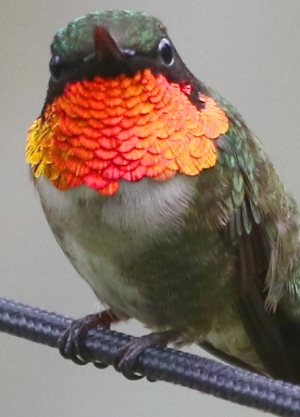
A Gorget is a bib of iridescent feathers that changes in color with viewing angle.
Easy to remember - Gorget = Gorgeous!
Note: Occasional females can have one to a few iridescent red feathers in the throat as well as young males before their 1st molt.
See Hummingbirds Fly, Shake, Drink in Amazing Slow Motion!
Ruby-throated Measurements
Length:
3.75" (10 cm) - Shorter than a popsicle stick!
Weight:
0.11 oz (3.2 g) - Weight of a penny!
Diet- Nectar, Insects, Even Sap!
Some Of Their Favorite Flowering Plants
- Autumn sage (Salvia greggii)
- Bee balm (Monarda didyma)
- Standing cypress (Ipomopsis rubra)
- Eastern columbine (Aquilegia canadensis)
- Cardinal flower (Lobelia cardinalis)
- Gladiolas (Gladiolus spp.)
- Nasturtium (Tropaeolum majus)
- Red buckye (Aesculus pavia)
- Firebush (Hamelia patens)
- Trumpet creeper (Campsis radicans)
- Spotted Jewelweed (Impatiens capensis)
- Trumpet honeysuckle (Lonicera sempervirens)
- Indian Pink (Spigelia marilandica)
- Texas paintbrush (Castilleja indivisa)
They Also Eat Sap!
The ruby-throated hummingbird's diet consists of nectar, insects, and spiders, but will also take tree sap from woodpecker drillings.
Video of Hummingbird Sipping Sap
Their northern distribution may depend on availability of this tree sap provided by sapsuckers' drillings when flower blooms are not as abundant.
Male Courtship Display - Trying To Impress!
During courtship, male Ruby-throated hummingbirds perform a pendulum-arc-flight before the female, rising 3'-40' above and 5'-6' to each side of her, diving back and forth in a U-shaped arc.
At the bottom of the arc, a loud buzz is made from the wings & tail.
Nest-building
The ruby-throated hummingbird nests in deciduous or mixed
woodlands, open areas with scattered trees, parks, and gardens.
The female builds the nest by herself, which may take from 1-10 days, depending on weather conditions and difficulty of gathering material.
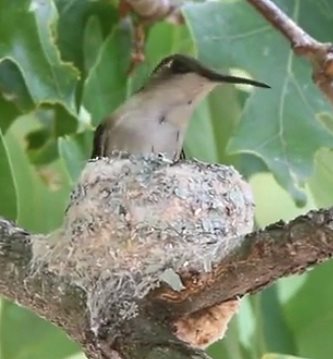
The nest is built on a small, downward-inclined deciduous, occasionally coniferous limb, often near or over water, such as a brook or stream.
The nest is composed of bud scales (winter coverings of flowers and leaves), lichen on the exterior, bound with spider's silk and lined with soft plant down.
Viewed from the ground, the nest looks like a mossy knot on a limb.
Old nests are occasionally occupied for several seasons and refurbished annually.
Nest height ranges from 4'-50' but is usually 10'-20' off the ground.
The outside diameter of the nest is between 1-1.75" (2.5-4.4 cm), no bigger than a half dollar!
Breeding
- Eggs: Usually 2. Shell is smooth, no gloss & pure white; measures 12.9 x 8.5 mm, not much bigger than a jelly bean!
- Incubation: About 16 days, by female only
- Nestling Phase: 14-31 days
- Fledgling phase: Up to 34 days
- Broods: 1-2, rarely 3
Eggs are usually laid in the morning with an interval of one day between egg laying.
The female usually starts incubating after the last egg is laid. She incubates from 60-80% of the day, depending on the weather.
Ruby-throated Hummingbird Feeding Nestlings
Hatchlings are altricial. No bigger than peas, they are blind, nearly featherless, and virtually helpless and in need of constant care.
Nestlings rely entirely on the mother for warmth until about 8-12 days when they are then able to maintain their own body temperatures.
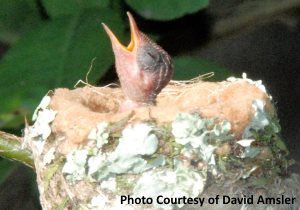
Brooding periods vary with weather. Where there is abundant food and the weather is milder, the young may grow faster and leave the nest earlier.
Nestlings are fed from 1 to 3 times every hour.
They are fed by regurgitation, usually while the female is hovering.
The mother inserts her bill into the nestling's throat and pumps in nectar & insects.

Young ruby-throated hummingbirds will begin exercising & strengthening their wings by rapidly beating them while still in the nest.
Preparing for their first flight, they will practice, but with caution.
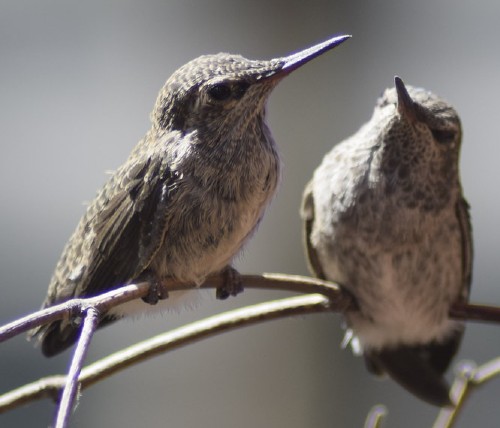
They will hold on to the rim of their tiny nest-cup with their feet to prevent themselves from being swept upwards before they are ready for it.
When they are ready to leave, the fledglings often choose the morning hours for their first flights, which are sometimes over 50 feet.
They are usually quite adept at flying almost immediately, although landing takes more practice.
The fledglings usually stay in the vicinity of the nest, sometimes up to 20 days or more.
The female may continue to feed the young during this time, although the young explore many flowers and come to learn which ones are rich in nectar.
Call Sounds
Ruby-throated hummingbird calls are a soft and husky tchew like black-chinned hummingbirds, but may average slightly sharper and higher.
It is also described as a rapid squeaky chipping sound.
Here are some display sounds of the Ruby-throated hummingbird.
Their chase call is a sharp, sputtering zeeek ididididid, like a black-chinned, often repeated.
Their song from a perch is a faint, high rattling teeteeteetee.
Adult male's wings also produce a very faint, high buzz in flight.
Flight
Hummingbirds have many skeletal and flight muscle adaptations that allow for hovering and high maneuverability in flight.
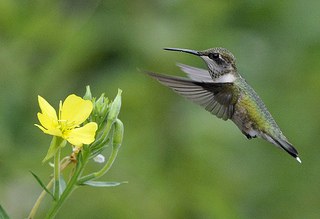
They have compact, strongly muscled bodies.
Muscles make up 25-30% of their body weight.
They have rather long, bladelike wings that, unlike the wings of other birds, articulate (connect) to the body only from the shoulder joint.
It is at this joint that the wing rotates almost 180 degrees to enable the bird to fly in its distinctive way.
Other birds can generate power only on the downstroke, but hummingbirds can move freely in any direction.
Their wing architecture permits hummingbirds to fly not only forward but also straight up and down, sideways, and backwards and to hover in front of flowers as they obtain nectar and insects
During hovering, ruby-throated hummingbird wings beat 55x/sec, 61x/sec when moving backwards, and at least 75x/sec when moving forward.
Migration
Sexes apparently migrate separately; older males first to arrive and to depart.
In the spring, the earliest females and many of the young males lag behind by 7-10 days.
Latest hummingbird sightings:
In the fall, males may leave as early as July.
Most ruby-throats are gone in the U.S. by the end of September.
Some stragglers may remain in southern Florida through the winter.
Spring migration can occur as early as February.
Here are current migration maps to see the first reported birds in your area.
Factors such as weather, length of daylight, & fat accumulation stimulate migration.
Some birds may travel 2,000 miles or more from Panama to their breeding destination in Canada!
Hummingbirds migrate alone, not in flocks, and not on the backs of geese!
Ruby-throated hummingbirds mostly winter in Mexico and Central America.
They fly 500 miles non-stop across the Gulf of Mexico, able to store enough fat to make this over-water crossing.
Territory
Male ruby-throated hummingbirds returning from migration ahead of the females seek out areas with nectar-rich flowers, such as gardens, where they may establish a territory of a quarter acre or more.
You will often see males defending a food supply from other male & female hummers.
They have favorite perches, usually on a high branch near a flowering bush or feeder. This elevated position gives them an excellent vantage point to watch over their territory.
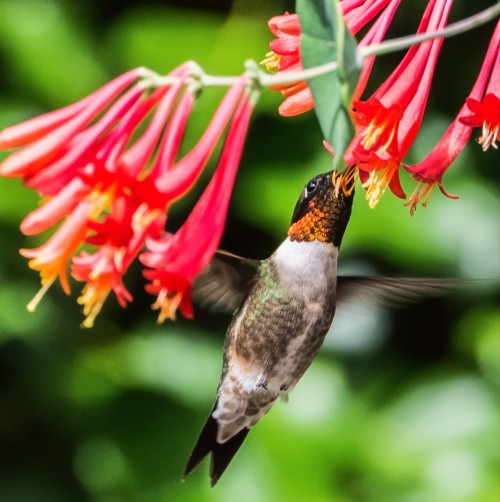
Male hummers will not hesitate to descend aggressively upon almost any intruder in their territory including larger birds, cats, squirrels, human beings, butterflies, moths, bees, wasps, and/or yellow jackets.
When an intruder is spotted, they will fly directly at them, chasing the trespasser out of its territory.
A nesting female ruby-throated hummingbird will often establish a temporary territory in the vicinity of her nest that she will defend against interlopers by aerial pursuit.
This territory and that of her mate are often different.
Longevity Record
The longest living ruby-throated hummingbird recorded is 9 Years and 1 months (according to USGS Bird Banding Lab).
Summer Range
Ruby-throated hummingbirds breed from central Alberta eastward to
Nova Scotia, southward from eastern North Dakota to eastern Texas and Florida.
Winter Range
In the U.S., winters in Florida and along the Gulf Coast, with occasional winter
stragglers recorded northward.
Others spend most of the winter in southern Mexico and Central America south to Costa Rica.
Related Hummingbird Pages:
Ruby-throated Hummingbird photos courtesy of Jeff Bryant and Pauline Horn.
|
Our Favorite Bird Watching Binoculars, Squirrel-Proof Feeder & Hummingbird Feeder Read Our Reviews: |
||
Nikon Monarch M5
Best mid-priced bird watching binoculars. Waterproof, shockproof, multi-coated ED-Glass. |
|
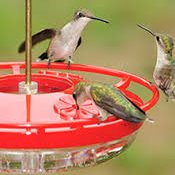
Best Hummingbird Feeder
Drip-Free, Ant-moat, Durable, Easy to Fill and Clean. |
| Click Images or Links To View More Info | ||